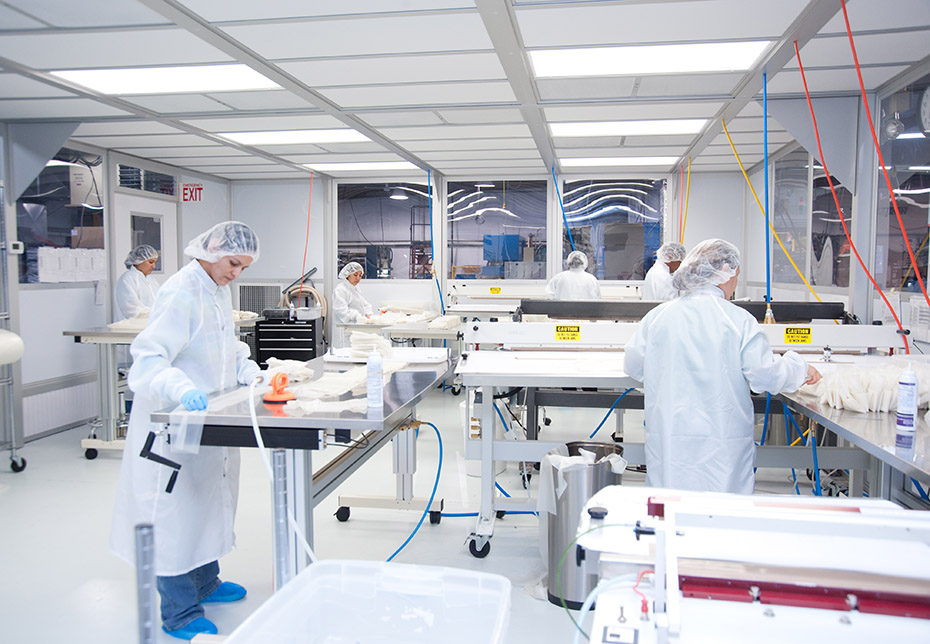
In chip manufacturing, Airborne Molecular Contaminants (AMC) are invisible to the naked eye. They can cause wafer oxidation, photoresist failure and circuit corrosion, directly affecting chip yield. Below we break down the core points of AMC control in chip cleanrooms from three aspects: design, construction and monitoring.
I. Design Phase: Pre-identify AMC Risk Sources and Customize Control Solutions
1.Risk Classification and Zoned Control
Divide control levels based on the sensitivity of chip processes such as lithography, etching and metal deposition to AMC. For example, the lithography area focuses on preventing organic amines and aldehydes to avoid impacting photoresist photosensitivity. The metal deposition area prioritizes controlling corrosive gases such as sulfur and chlorine to prevent oxidation of metal wiring. Different zones adopt independent air circulation systems to avoid cross-contamination.
2.Specialized Design of Purification Systems
On the basis of conventional HEPA/ULPA filtration, add multi-stage AMC filtration modules. Install activated carbon filters in the pre-treatment stage to adsorb large-particle organic contaminants. Equip the precision treatment stage with dedicated filters for specific contaminants, such as alumina to adsorb acidic gases and molecular sieves to adsorb alkaline gases. Install additional photocatalytic oxidation devices in the lithography area to decompose trace organic contaminants. For local microenvironment enhancement, set up point-to-point AMC purification units near wafer transfer chambers and lithography equipment to ensure contaminant concentration in key zones is ≤ 1ppb.
3.Material Selection to Avoid Contamination
Cleanroom enclosure materials such as color steel plates and sealants, as well as interior finishes such as floor coverings, should adopt low-volatility and low-emission materials. Prioritize products that pass semiconductor industry low-molecular contaminant emission tests to prevent materials themselves from becoming AMC sources.
II. Construction Phase: Strictly Control Construction Contamination and Ensure System Efficiency
1.Construction Environment Management
Temporarily seal clean zones during construction and adopt clean construction methods. All materials entering the site must undergo cleaning and decontamination, such as wiping metal components with isopropanol. Construction personnel wear dedicated dust-free and low-volatility protective clothing to avoid introducing contaminants such as grease and solvents during construction.
2.Precision Control of System Installation
Adopt zero-leakage sealing technology for connections between AMC filtration modules and air ducts. Use fluororubber sealing rings and evenly tighten bolts to prevent unfiltered air from infiltrating. Conduct mirror polishing on duct inner walls to achieve a roughness Ra ≤ 0.4μm, reducing contaminant adhesion and residue. Perform air tightness tests after installation to ensure leakage rate ≤ 0.1%.
3.Pre-treatment of Equipment Before On-site Entry
Conduct contaminant emission tests on core equipment such as lithography machines and wafer transfer machines outside the cleanroom before entry. Qualified equipment can enter the clean zone through a dedicated air lock chamber. Select low-volatility media for internal cooling and lubrication systems of equipment to avoid AMC emission during operation.
III. Operation and Monitoring Phase: Real-time Monitoring and Dynamic Adjustment
1.Real-time Online Monitoring
Deploy AMC online monitoring sensors near various process zones and key equipment in the cleanroom. Collect real-time concentration data of organic contaminants (VOCs), acidic gases (NOx, SO2) and alkaline gases (NH3). Connect data to the central control system. When concentrations exceed limits, automatic alarms are triggered, and the purification system is linked to enhance filtration intensity.
2.Regular Offline Testing
Entrust third-party institutions to conduct offline sampling and analysis monthly. Use Gas Chromatography-Mass Spectrometry (GC-MS) technology to detect trace AMC components and concentrations. Evaluate filtration system efficiency by comparing data with process threshold requirements. Replace ineffective AMC filtration modules in a timely manner based on contaminant adsorption capacity, with a typical replacement cycle of 6–12 months.
3.Process-linked Adjustment
When upgrading chip processes, such as shifting from 14nm to 7nm, AMC control indicators must be optimized synchronously. For example, the 7nm process has stricter requirements for controlling metal ions such as Na+ and K+. It is necessary to add ion exchange filters to the purification system to ensure contaminant concentrations meet new process demands.