
Class 100 Clean Room (ISO 5): Design Standards, Applications & Cleanroom Solutions
What Is a Class 100 Clean Room?
A Class 100 Clean Room is a highly controlled environment designed to limit airborne particle contamination to no more than 100 particles measuring 0.5 microns or larger per cubic foot of air. Under current international standards, a Class 100 Clean Room is equivalent to an ISO 5 Cleanroom as defined by ISO 14644-1.
Because contamination can directly affect product quality, yield rates, and regulatory compliance, a Class 100 Clean Room is widely used in semiconductor manufacturing, biotechnology laboratories, pharmaceutical production, precision optics, and aerospace assembly.
For industries where even microscopic particles can cause defects, a properly designed Class 100 Clean Room provides the level of environmental control necessary for stable and reliable production.
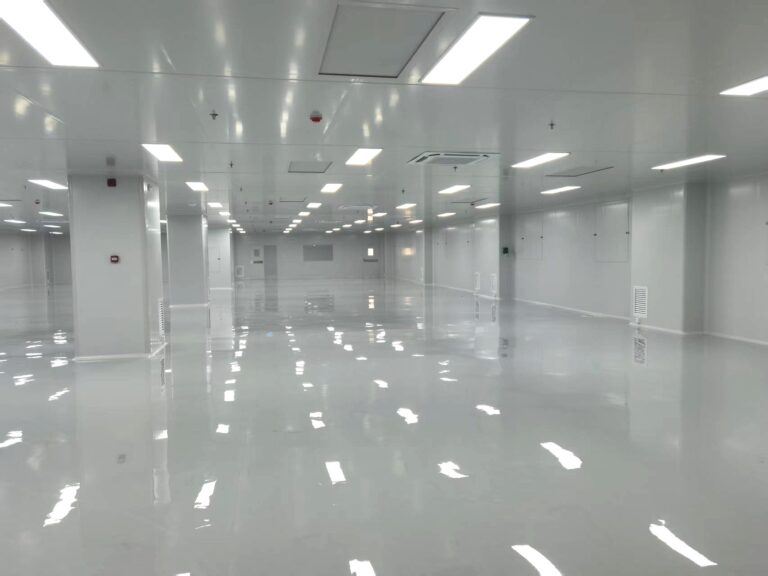
Class 100 Clean Room Standards Explained
The term Class 100 Clean Room originates from the former Federal Standard 209E classification system.
| Classification | Maximum Particles ≥0.5μm |
|---|---|
| Class 10 | 10 particles/ft³ |
| Class 100 | 100 particles/ft³ |
| Class 1,000 | 1,000 particles/ft³ |
| Class 10,000 | 10,000 particles/ft³ |
Under ISO 14644-1, a Class 100 Clean Room corresponds to:
| Standard | Classification |
|---|---|
| Federal Standard 209E | Class 100 |
| ISO 14644-1 | ISO 5 |
| Maximum Particle Count | 3,520 particles/m³ |
Although Federal Standard 209E has been replaced by ISO standards, the term Class 100 Clean Room remains widely used across the semiconductor, pharmaceutical, and electronics industries.
Key Features of a Class 100 Clean Room
Achieving ISO 5 cleanliness requires more than simply installing filters. A successful Class 100 Clean Room integrates multiple engineering systems working together to control contamination.
High-Efficiency Filtration
HEPA or ULPA filtration systems remove airborne particles before they enter the critical production area.
Typical filtration efficiency:
- HEPA: 99.97% at 0.3μm
- High-performance HEPA: up to 99.995%
- ULPA: up to 99.9995%
Unidirectional Laminar Airflow
A Class 100 Clean Room typically uses vertical laminar airflow to continuously sweep particles away from critical work zones.
Benefits include:
- Reduced turbulence
- Improved particle control
- Consistent cleanliness performance
High Air Change Rates
Most ISO 5 cleanrooms operate between:
240–480 air changes per hour (ACH)
This rapid airflow helps maintain stable particle counts and prevents contamination accumulation.
Positive Pressure Control
Positive pressure ensures that air flows outward whenever doors are opened, preventing contaminants from entering the clean area.
Cleanroom-Compatible Materials
Common construction materials include:
- Sandwich wall panels
- Epoxy flooring
- Stainless steel components
- Rounded corners for easier cleaning
- Non-particle-shedding surfaces
Industries That Require a Class 100 Clean Room
Semiconductor Manufacturing
Semiconductor fabrication processes involve microscopic circuit structures that can be damaged by extremely small particles.
A Class 100 Clean Room is commonly used for:
- Wafer processing
- Photolithography
- Chip packaging
- Precision inspection
Pharmaceutical Production
Many pharmaceutical operations require ISO 5 environments for critical manufacturing processes.
Applications include:
- Sterile filling areas
- Aseptic processing zones
- Compounding operations
Biotechnology Laboratories
Research and production environments often require a Class 100 Clean Room to protect samples and maintain experimental accuracy.
Precision Optics and Photonics
Dust contamination can affect lens quality, optical coatings, and laser performance.
Typical applications include:
- Optical assembly
- Lens manufacturing
- Laser component production
Aerospace and Advanced Manufacturing
Sensitive aerospace sensors and electronic components are frequently assembled inside ISO 5 environments.
Essential Equipment for a Class 100 Clean Room
A properly functioning Class 100 Clean Room depends on specialized cleanroom equipment.
Typical configurations include:
Air Showers
Air showers help remove contaminants from personnel before entering critical areas.
Pass Boxes
Pass boxes reduce contamination risks during material transfer.
Fan Filter Units (FFU)
FFUs provide localized HEPA-filtered airflow and are widely used in modular cleanroom systems.
Clean Benches
Laminar flow clean benches create ISO 5 work zones for precision operations.
HEPA Terminal Units
Terminal filtration systems provide final-stage particle control before air enters the cleanroom.
Baihong Purification manufactures a complete range of cleanroom equipment including air showers, pass boxes, FFUs, clean benches, and HEPA filtration systems to support ISO 5 cleanroom applications.
How a Class 100 Clean Room Is Designed
Every Class 100 Clean Room should be customized according to the production process, cleanliness requirements, and facility layout.
The design process typically includes:
- Cleanliness classification analysis
- Airflow simulation and HVAC design
- Equipment layout planning
- Pressure cascade design
- Filtration system selection
- Validation and commissioning
For semiconductor and precision manufacturing projects, contamination control should be considered from the earliest planning stages to ensure long-term performance.
Testing and Validation of a Class 100 Clean Room
After construction, a Class 100 Clean Room must be validated to verify compliance with ISO 14644 standards.
Common tests include:
- Airborne particle count testing
- Airflow velocity testing
- Air change rate verification
- Differential pressure testing
- HEPA filter integrity testing
- Temperature and humidity verification
Regular monitoring helps maintain cleanroom performance throughout its operational life.
Why Choose Baihong Purification?
Baihong Purification specializes in cleanroom equipment manufacturing and cleanroom solutions for semiconductor, pharmaceutical, electronics, food, optics, and precision manufacturing industries.
Our capabilities include:
- Cleanroom design support
- Air shower manufacturing
- Pass box manufacturing
- FFU systems
- Clean benches
- HEPA filtration solutions
- Modular cleanroom systems
- Installation guidance and technical support
With in-house R&D, quality-controlled production, CE-certified products, and extensive project experience, we help customers build reliable and compliant Class 100 Clean Room environments.
FAQs About Class 100 Cleanrooms
Q: Is Class 100 the same as ISO 5?
Yes. ISO 5 is the international equivalent of Class 100 under the older US FED-STD-209E.
Q:How many air changes are required for a Class 100 Clean Room?
Most ISO 5 cleanrooms operate between 240 and 480 air changes per hour, depending on the process requirements and room configuration.
Q: What filter is used in a Class 100 Clean Room?
HEPA or ULPA filters are typically used to achieve the required particle control levels.
Q:Can a modular cleanroom achieve Class 100 standards?
Yes. Properly designed modular cleanrooms equipped with HEPA filtration and laminar airflow systems can meet ISO 5 requirements.
Q:What industries commonly use Class 100 Clean Rooms?
Semiconductor manufacturing, biotechnology, pharmaceuticals, aerospace, precision optics, and advanced electronics manufacturing are among the most common applications.
Request a Quote or Consultation
Whether you need a single clean zone or a full-scale Class 100 facility, we can help.