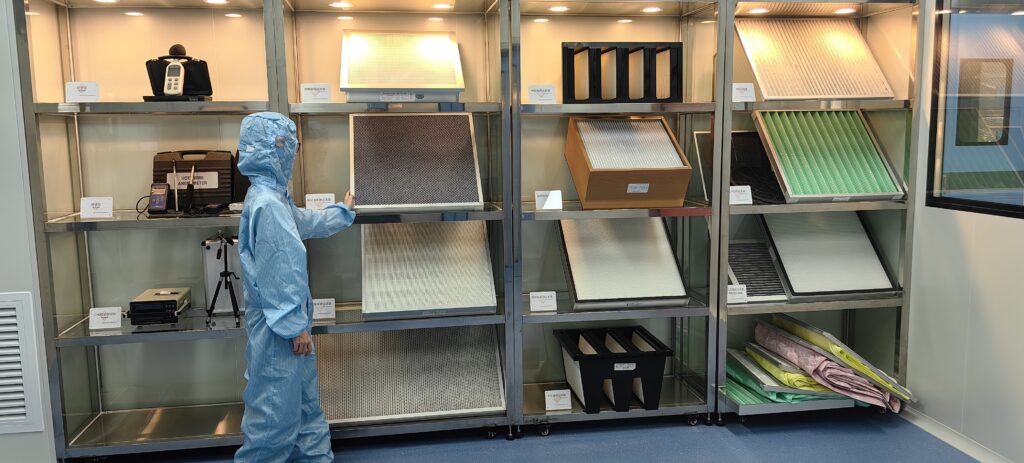
When planning and selecting air filters for a cleanroom, the core is to first clarify the cleanliness level, then match the air volume, air pressure, and installation space. The air filtration effect is directly related to the accuracy of selection. This article outlines 3 steps to help enterprises efficiently choose the right air filters, while introducing key technical indicators and professional brand guarantees to assist in cost control and improved cleanliness efficiency.
Step 1: Clarify Core Requirements – The Foundation for Air Filter Selection
The basis for choosing air filters is to determine the cleanroom’s cleanliness level and designed air volume. Different industries have significantly different needs: the electronics industry often requires ISO 7 or ISO 6 cleanliness standards, while the food industry mostly adopts ISO 8 standards. After confirming the cleanliness level, it is necessary to simultaneously determine the designed air volume. Together, these two factors form the core basis for air filter selection, avoiding subsequent selection deviations.
Step 2: Make Decisions Based on Space
Select air filters according to the cleanroom’s spatial conditions and cleanliness level: if the cleanroom has sufficient floor height, spacious installation area, and a limited budget, bag filters with separators can be used for ISO 8 and below scenarios; if the cleanroom space is compact, such as laboratories and precision electronics workshops, or requires high cleanliness levels like ISO 7 and above, pleated filters without separators are preferred. Their thin and light characteristics can significantly save ceiling or equipment room space while ensuring air filtration efficiency and space utilization.
Step 3: Consider Long-Term Use
The operating mode determines the long-term cost-effectiveness of air filters: for cleanrooms requiring 24/7 continuous operation, pleated filters without separators offer more uniform air flow and slower efficiency decay, resulting in lower long-term maintenance costs; for ordinary industrial cleanrooms with intermittent use, bag filters with separators provide better cost-effectiveness.
In addition, the two types have different test reference indicators: bag-type high-efficiency air filters use 0.5μm particles as the test reference, while pleated high-efficiency air filters use 0.3μm particles. Further screening can be done based on actual filtration precision requirements.
Professional Brand
With over a decade of deep expertise in the industry, Baihong Purification has always centered on quality and upheld its commitments to quality and service. We help customers ensure smooth production progress, enhance product yield and stability, maximize low-consumption operation, and thus achieve effective cost savings.