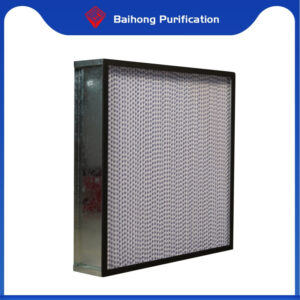
As a key purification component in clean environments, HEPA filter cassette affects air filtration efficiency and cleanliness level. Among them, HEPA filter cassette with separator and HEPA filter cassette without separator are the two mainstream types, which have significant differences in structural design, performance advantages and application scenarios. From a practical perspective, this article clearly compares the core differences between the two to help enterprises quickly select the right type.
I. What is a HEPA Filter Cassette
HEPA filter cassette is the core component of clean environment control, mainly used to capture tiny particles, impurities and microorganisms in the air, ensuring the cleanliness of the space.
II. HEPA Filter Cassette with Separator
HEPA filter cassette with separator uses aluminum foil or paper separators as support to fix glass fiber filter media, forming stable filtration channels.
- Core Structure: Aluminum foil, paper and other materials are used as separators to fix glass fiber filter media, with uniform filtration channels, moderate wind resistance and convenient later maintenance;
- Core Advantages: Stable craftsmanship, high cost performance, low maintenance cost, no complex operation required, suitable for conventional clean needs;
- Application Scenarios: Class 10,000 and Class 100,000 clean rooms, such as ordinary electronic workshops, food processing workshops, conventional laboratories, etc., most conventional clean rooms.
III. HEPA Filter Cassette Without Separator
HEPA filter cassette without separator uses hot melt adhesive lines instead of traditional separators, and the filter paper is folded more uniformly and tightly.
- Core Structure: The filter media is fixed by hot melt adhesive lines, the filter paper is folded uniformly and densely, and the overall structure is thin and light;
- Core Advantages: Low wind resistance, high filtration efficiency, good sealing performance, lower leakage risk and longer service life;
- Application Scenarios: High-grade clean rooms such as Class 1,000 and Class 100, such as PCB electronic workshops, pharmaceutical production workshops, FFU fan filter units, etc., suitable for high-end production and scientific research scenarios with high requirements for cleanliness.
IV. Core Differences
Comparison Dimension | HEPA Filter Cassette with Separator | HEPA Filter Cassette Without Separator |
Core Structure | Filter media supported by aluminum foil/paper separators | Filter media fixed by hot melt adhesive lines, no physical separators |
Core Advantages | Mature craftsmanship, high cost performance, simple maintenance | Low wind resistance, high filtration efficiency, space-saving |
Application Scenarios | Class 10,000 and Class 100,000 clean rooms, conventional production/research scenarios | Class 1,000 and Class 100 clean rooms, high-end production/research scenarios |
Maintenance Cost | Simple maintenance, low cost | Long service life, low long-term maintenance cost |
V. Selection Suggestions
- Conventional Clean Needs (Class 10,000 and Class 100,000): Prioritize HEPA filter cassette with separator, which has higher cost performance and lower maintenance cost, suitable for ordinary production and scientific research scenarios;
- High-end Clean Needs (Class 1,000 and Class 100): Prioritize HEPA filter cassette without separator, suitable for high-cleanliness production, medical treatment, precision electronics and other scenarios, reducing later rework and energy consumption;
- Core Principle: Select according to your own cleanliness level needs, just fit the actual production needs, and balance practicality and economy.