
Introduction
Modern SMT production relies on increasingly sensitive electronic components, where even a small electrostatic discharge (ESD) can affect product quality or reduce manufacturing yield. While a standard air shower effectively removes dust and airborne particles from personnel before entering a cleanroom, it cannot eliminate static electricity carried by operators or garments.
An Anti-Static Air Shower is designed to solve this challenge. By integrating an ionizing system into a conventional air shower, it provides both contamination control and electrostatic protection, making it an ideal anti-static cleanroom entrance solution for electronics manufacturing environments.
Unlike a standard air shower, an Anti-Static Air Shower combines high-velocity HEPA-filtered airflow with ionization technology to reduce electrostatic charges before personnel enter ESD-sensitive production areas. For industries such as SMT assembly, semiconductor manufacturing, PCB production, lithium battery manufacturing, and precision electronics, this dual-protection approach helps improve process stability while supporting cleanroom contamination control.
Why a Standard Air Shower Is Not Enough
A conventional air shower is designed to remove loose dust and particles from personnel and garments using high-speed filtered air. Typical systems operate with HEPA filtration efficiency of 99.99% at 0.3 μm and air velocities between 20–25 m/s, significantly reducing particulate contamination before personnel enter controlled environments.
However, particle removal is only one part of cleanroom protection.
Operators walking on floors, wearing protective clothing, or handling packaging materials continuously generate static electricity through friction. In dry environments, the accumulated electrostatic voltage can reach several thousand volts, even though the operator may not feel it.
For ESD-sensitive manufacturing processes, these electrostatic charges may result in:
- Damage to integrated circuits (ICs)
- Reduced reliability of PCB assemblies
- Latent defects that are difficult to detect during inspection
- Production instability and unnecessary product loss
Because a standard air shower only removes particles, it cannot neutralize static charges on personnel. This is why many electronics manufacturers choose an Anti-Static Air Shower or ESD Air Shower as part of their cleanroom entry process.
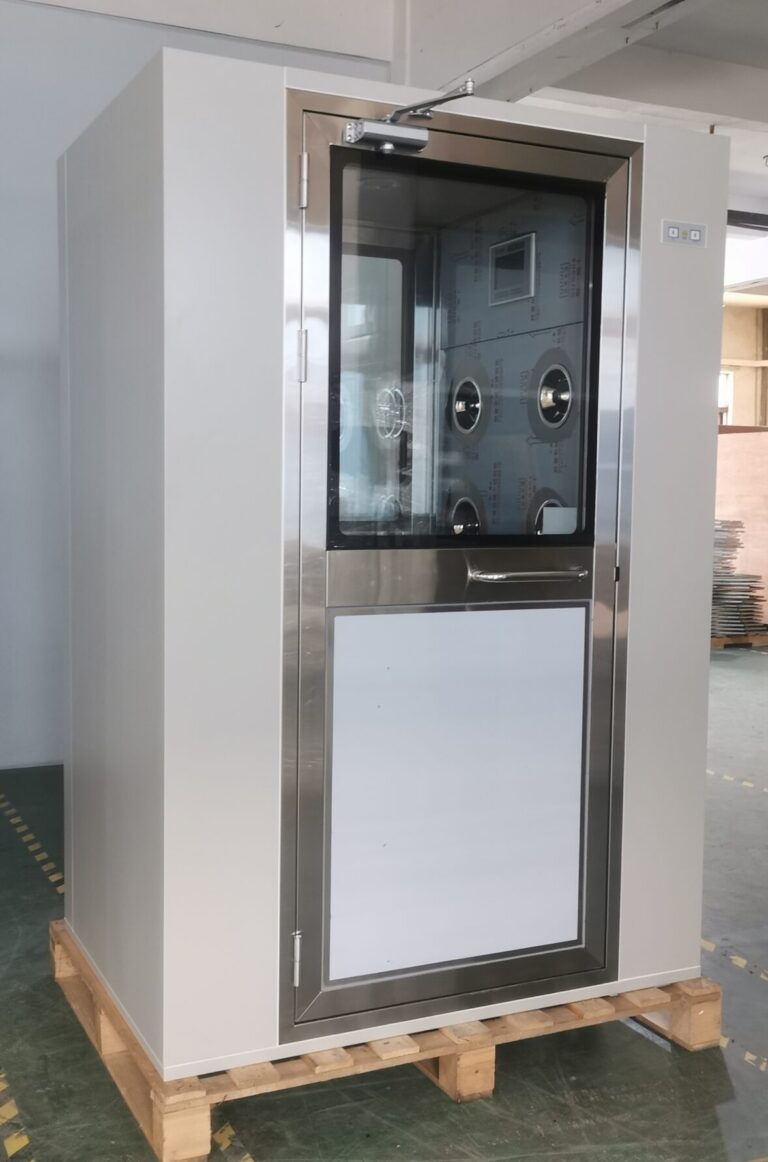
How an Anti-Static Air Shower Works
An Anti-Static Air Shower is not an entirely different type of equipment. Instead, it is a customized air shower equipped with an ionizing system, often referred to as an ionizing air shower.
The operating process typically includes the following steps:
- Personnel enter the air shower and both doors are electronically interlocked.
- HEPA-filtered high-speed airflow removes dust and loose contaminants from clothing.
- Integrated ionizing bars generate balanced positive and negative ions.
- These ions neutralize static charges accumulated on garments and the human body.
- Personnel enter the cleanroom with significantly lower particle contamination and reduced electrostatic risk.
This combination of contamination removal and electrostatic neutralization creates a more reliable anti-static cleanroom entrance, particularly for facilities where product sensitivity is extremely high.
Typical Applications of an Anti-Static Air Shower
An Anti-Static Air Shower is generally recommended whenever contamination control and electrostatic protection are equally important.
Typical applications include:
- SMT production workshops
- PCB assembly plants
- Semiconductor manufacturing
- Electronic component production
- Lithium battery manufacturing
- Precision optical manufacturing
- Medical electronics production
- High-grade cleanroom laboratories
These environments often operate comprehensive ESD control systems, including anti-static flooring, grounding devices, conductive footwear, ESD garments, wrist straps, humidity control, and ionization equipment. An Anti-Static Air Shower becomes the first protective barrier before personnel enter these controlled production areas.
Rather than replacing existing ESD measures, the system complements the overall electrostatic protection strategy by reducing both airborne particles and human static charges at the cleanroom entrance.
Key Design Considerations
Because every manufacturing process has different ESD requirements, an Anti-Static Air Shower is usually designed as a customized solution rather than a standard product.
Several engineering factors should be considered during project planning:
| Item | Typical Specification |
|---|---|
| Air Velocity | 22–25 m/s |
| HEPA Filter Efficiency | 99.99% @ 0.3 μm |
| Ionizing Device | Ionizing Bar or Ionizing Blower |
| Door System | Electronic Interlock |
| Construction Material | Powder-Coated Steel or SUS304 Stainless Steel |
| Control System | PLC with Automatic Blowing |
| Optional Functions | Access Control, Card Reader, Face Recognition |
The selection of ionizing equipment depends on production requirements, cleanroom classification, personnel flow, and ESD control standards.
Instead of installing ionization devices independently after construction, integrating them into the Anti-Static Air Shower simplifies cleanroom entry management and provides a more consistent operating process.
Engineering Example
One electronics manufacturer operating an SMT assembly workshop required improved electrostatic protection at the cleanroom entrance while maintaining existing contamination control standards.
After evaluating the production process, Baihong Purification supplied a customized Anti-Static Air Shower equipped with an integrated ionizing bar, HEPA filtration system, electronic interlock doors, and automatic blowing control.
The objective was not simply to remove dust from personnel but to create a controlled transition point where airborne particles and static electricity could both be addressed before operators entered the ESD-sensitive production area.
Although every project has unique technical requirements, this type of ionizing air shower solution is increasingly adopted by electronics manufacturers seeking more comprehensive cleanroom entry protection.
Why Manufacturers Choose an Anti-Static Air Shower
Compared with a conventional air shower, an Anti-Static Air Shower provides additional value for facilities handling sensitive electronic products.
Key advantages include:
- Simultaneous particle removal and electrostatic protection
- Improved cleanroom entry management
- Better compatibility with ESD control systems
- Reduced risk of electrostatic discharge during personnel entry
- Suitable for customized cleanroom layouts
- Flexible integration with access control and automation systems
As electronic components continue to become smaller and more sensitive, the combination of cleanliness and electrostatic control has become increasingly important. For many SMT and semiconductor manufacturers, installing an Anti-Static Air Shower represents an effective way to strengthen the first line of defense in cleanroom contamination control.
Conclusion
An Anti-Static Air Shower is not intended to replace conventional cleanroom air showers. Instead, it extends their capability by integrating ionization technology, allowing manufacturers to address two critical challenges simultaneously: particulate contamination and electrostatic discharge.
For industries where ESD-sensitive products are manufactured, an Anti-Static Air Shower, also known as an ESD Air Shower or ionizing air shower, can become an important component of the overall electrostatic protection strategy. By combining high-efficiency particle removal with static neutralization, manufacturers can create a safer and more reliable anti-static cleanroom entrance while supporting long-term product quality and production stability.
Frequently Asked Questions
1. What is an Anti-Static Air Shower?
An Anti-Static Air Shower is a customized air shower equipped with ionizing devices that remove airborne particles while neutralizing static electricity before personnel enter ESD-sensitive cleanrooms.
2. Is an Anti-Static Air Shower different from a standard air shower?
Yes. A standard air shower focuses on particle removal, while an Anti-Static Air Shower combines HEPA-filtered airflow with ionization technology to provide additional electrostatic protection.
3. Which industries commonly use an Anti-Static Air Shower?
Typical users include SMT manufacturers, semiconductor factories, PCB assembly plants, lithium battery facilities, medical electronics manufacturers, and other ESD-sensitive industries.
4. Can an existing air shower be upgraded into an Anti-Static Air Shower?
In many cases, yes. Depending on the equipment structure, ionizing bars or other electrostatic control devices can often be integrated as part of a customized upgrade solution.
5. Does an Anti-Static Air Shower replace other ESD protection measures?
No. An Anti-Static Air Shower is only one part of a complete electrostatic protection system. It should be used together with grounding, ESD flooring, anti-static garments, humidity control, and other established ESD management practices.