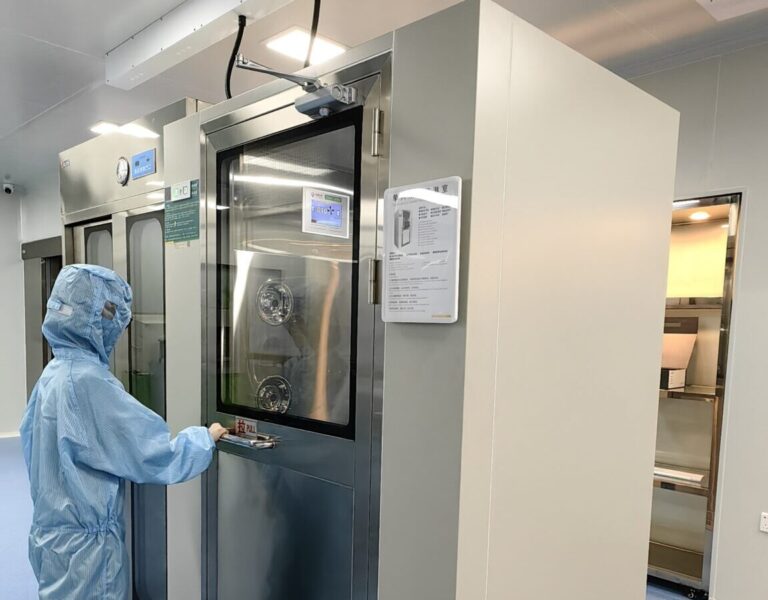
An air shower is a critical piece of purification equipment for cleanrooms, acting as the first line of defense to prevent personnel-carried dust and particles from entering the clean area. Choosing the right air shower that meets the cleanroom’s requirements is not only essential to maintaining the cleanliness level but also directly affects production efficiency, product quality, and compliance with industry standards. This article details the core cleanroom air shower selection standard, providing practical guidance and industry insights to help industrial enterprises, cleanroom designers, and procurement personnel make scientific and reasonable choices.
1. Determine the Cleanroom Class First (Core Selection Basis)
The primary basis for selecting a cleanroom air shower is the cleanroom class, which directly determines the air shower’s wind speed, filtration level, and structural design. Different cleanroom classes have distinct requirements for dust removal efficiency, and the air shower must be matched accordingly to avoid over-configuration (wasting costs) or under-configuration (failing to meet purification needs).
For ISO Class 5-6 cleanrooms (Class 100-Class 1000), the air shower requires a wind speed of 25-30 m/s and a HEPA H14 filter to ensure that 99.995% of particles above 0.3μm are filtered. For ISO Class 7-8 cleanrooms (Class 10,000-Class 100,000), a wind speed of 18-22 m/s and a HEPA H13 filter are sufficient to meet purification requirements. Industry data shows that improper matching between air shower and cleanroom class can reduce cleanroom cleanliness by 30% or more, affecting product qualification rates.
Different industrial scenarios and personnel flow volumes require different types of air showers, which is a key part of the cleanroom air shower selection standard. Blindly choosing a single type will lead to low usage efficiency and increased maintenance costs.
For small and medium-sized factories with low personnel flow (fewer than 50 people per hour), single-person single-blow air showers are cost-effective and can meet basic purification needs. For large-scale electronic or pharmaceutical factories with high personnel flow, double-person double-blow or multi-person air showers are more suitable, which can improve personnel passage efficiency and ensure uniform dust removal.
In addition, for cleanrooms with strict anti-cross-contamination requirements (such as pharmaceutical GMP workshops), air showers with interlock functions should be selected to prevent the simultaneous opening of both doors and avoid air convection between clean and non-clean areas. A survey of 50+ industrial enterprises shows that scenario-adapted air shower selection can reduce daily operation costs by 15%-20%.
3. Focus on Core Performance Indicators
When implementing the cleanroom air shower selection standard, core performance indicators cannot be ignored, as they directly determine the long-term stability and purification effect of the equipment. The key indicators to focus on include wind speed uniformity, filter service life, and noise level.
Wind speed uniformity ensures that all parts of the human body are fully blown and cleaned; the allowable error should not exceed ±2 m/s. High-quality HEPA filters have a service life of 12-18 months, while low-quality filters need to be replaced every 3-6 months, which increases maintenance costs. In addition, the noise level of the air shower should be controlled below 65 dB to avoid affecting the working environment of the workshop.
4. Consider Compliance and Long-Term Maintenance
Compliance with industry standards and convenience of long-term maintenance are often overlooked in the selection process, but they are crucial for the sustainable operation of cleanrooms. The selected air shower must comply with ISO 14644-1 and relevant industry standards to ensure that the cleanroom meets compliance requirements during inspection.
In terms of maintenance, it is recommended to choose air showers with detachable filters and easy-to-operate control panels, which can reduce maintenance difficulty and labor costs. Some advanced air showers are equipped with filter replacement reminders, which can help enterprises avoid equipment failure caused by overdue filter replacement.
Conclusion and Outlook
The cleanroom air shower selection standard is a systematic project that requires comprehensive consideration of cleanroom class, usage scenarios, performance indicators, and compliance requirements. With the continuous upgrading of industrial cleanroom technology, air showers are developing in the direction of intelligence and energy conservation, such as intelligent induction control and energy-saving fan design.
For enterprises, scientific selection of air showers not only ensures the stability of the cleanroom environment but also helps reduce operation and maintenance costs and improve production efficiency. In the future, as the requirements for cleanroom cleanliness continue to increase, the cleanroom air shower selection standard will be further refined, providing more detailed guidance for industrial applications.